1966 Socialist Republic of Romania 10 Lei Note - Choice of Grade/Condition - Wide Serial Number Type - 1966 Romania Ten Lei Banknote - P#94
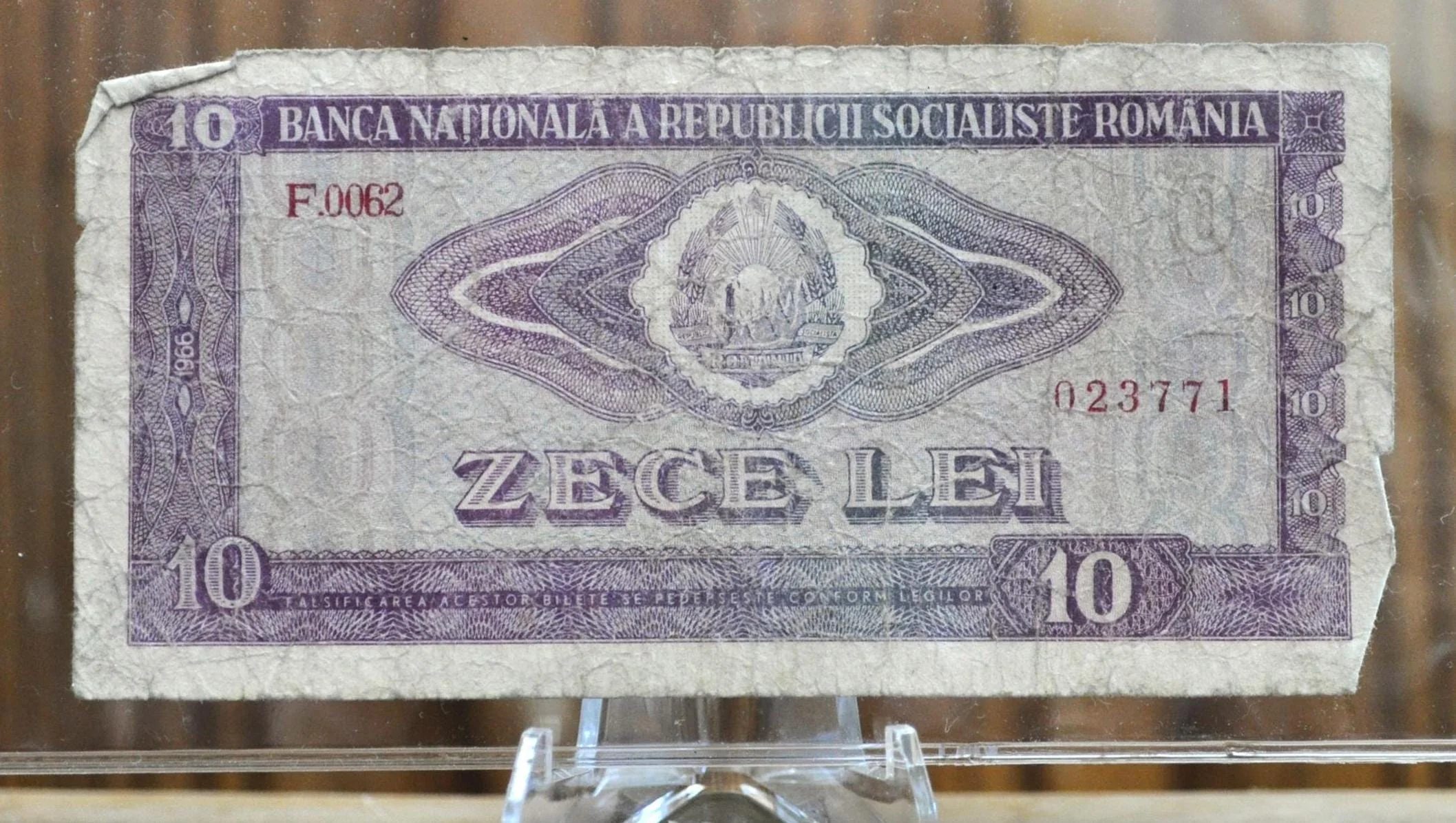
This listing is for the photographed 1966 Socialist Republic of Romania 10 Lei Banknote. This issue has a wide serial number prefix, differentiating it from other issues. Reverse print of a harvest scene. Choice of grade/condition. Incredibly interesting piece of history and the rise of socialism in the mid-20th century. P#94 (Pick Number 94).
The Socialist Republic of Romania, a Marxist-Leninist state, existed from 1947 to 1989. It was established after King Michael I was forced to abdicate on December 30, 1947, and the monarchy was abolished. Romania then became a people's republic, aligning itself with the Eastern Bloc under Soviet influence. The regime, led initially by the Romanian Communist Party (PCR) and later by Nicolae Ceaușescu, implemented strict authoritarian control over the economy, media, and society.
In the early years of the republic, banknotes were issued by the National Bank of Romania (Banca Națională a României - BNR) and featured themes aligned with socialist propaganda, including workers, peasants, and industrial imagery. During the rule of Nicolae Ceaușescu (from 1965 to 1989), Romanian currency continued to reflect socialist values. Paper money issued in this period often depicted images of industrial development, socialist leaders, and the accomplishments of the communist regime. Ceaușescu's cult of personality also began to emerge in later designs. The National Bank remained under strict government control, and all currency featured designs emphasizing the socialist state’s strength. In December 1989, Romania's socialist regime collapsed during the Romanian Revolution, which ended with the execution of Ceaușescu. The transition to a market economy eventually led to further currency reforms, including redenomination in the early 2000s, where the "new leu" (RON) replaced the older leu.
This note portrays the incredibly interesting economic history of Romania while a Socialist Republic, making it a must have for any collection!
Thanks for stopping by!
1966 Socialist Republic of Romania 10 Lei Note - Choice of Grade/Condition - Wide Serial Number Type - 1966 Romania Ten Lei Banknote - P#94
Product Information
Product Information
Shipping & Returns
Shipping & Returns



1966 Socialist Republic of Romania 10 Lei Note - Choice of Grade/Condition - Wide Serial Number Type - 1966 Romania Ten Lei Banknote - P#94
1966 Socialist Republic of Romania 10 Lei Note - Choice of Grade/Condition - Wide Serial Number Type - 1966 Romania Ten Lei Banknote - P#94
This listing is for the photographed 1966 Socialist Republic of Romania 10 Lei Banknote. This issue has a wide serial number prefix, differentiating it from other issues. Reverse print of a harvest scene. Choice of grade/condition. Incredibly interesting piece of history and the rise of socialism in the mid-20th century. P#94 (Pick Number 94).
The Socialist Republic of Romania, a Marxist-Leninist state, existed from 1947 to 1989. It was established after King Michael I was forced to abdicate on December 30, 1947, and the monarchy was abolished. Romania then became a people's republic, aligning itself with the Eastern Bloc under Soviet influence. The regime, led initially by the Romanian Communist Party (PCR) and later by Nicolae Ceaușescu, implemented strict authoritarian control over the economy, media, and society.
In the early years of the republic, banknotes were issued by the National Bank of Romania (Banca Națională a României - BNR) and featured themes aligned with socialist propaganda, including workers, peasants, and industrial imagery. During the rule of Nicolae Ceaușescu (from 1965 to 1989), Romanian currency continued to reflect socialist values. Paper money issued in this period often depicted images of industrial development, socialist leaders, and the accomplishments of the communist regime. Ceaușescu's cult of personality also began to emerge in later designs. The National Bank remained under strict government control, and all currency featured designs emphasizing the socialist state’s strength. In December 1989, Romania's socialist regime collapsed during the Romanian Revolution, which ended with the execution of Ceaușescu. The transition to a market economy eventually led to further currency reforms, including redenomination in the early 2000s, where the "new leu" (RON) replaced the older leu.
This note portrays the incredibly interesting economic history of Romania while a Socialist Republic, making it a must have for any collection!
Thanks for stopping by!
1966 Socialist Republic of Romania 10 Lei Note - Choice of Grade/Condition - Wide Serial Number Type - 1966 Romania Ten Lei Banknote - P#94
Product Information
Product Information
Shipping & Returns
Shipping & Returns
Description
This listing is for the photographed 1966 Socialist Republic of Romania 10 Lei Banknote. This issue has a wide serial number prefix, differentiating it from other issues. Reverse print of a harvest scene. Choice of grade/condition. Incredibly interesting piece of history and the rise of socialism in the mid-20th century. P#94 (Pick Number 94).
The Socialist Republic of Romania, a Marxist-Leninist state, existed from 1947 to 1989. It was established after King Michael I was forced to abdicate on December 30, 1947, and the monarchy was abolished. Romania then became a people's republic, aligning itself with the Eastern Bloc under Soviet influence. The regime, led initially by the Romanian Communist Party (PCR) and later by Nicolae Ceaușescu, implemented strict authoritarian control over the economy, media, and society.
In the early years of the republic, banknotes were issued by the National Bank of Romania (Banca Națională a României - BNR) and featured themes aligned with socialist propaganda, including workers, peasants, and industrial imagery. During the rule of Nicolae Ceaușescu (from 1965 to 1989), Romanian currency continued to reflect socialist values. Paper money issued in this period often depicted images of industrial development, socialist leaders, and the accomplishments of the communist regime. Ceaușescu's cult of personality also began to emerge in later designs. The National Bank remained under strict government control, and all currency featured designs emphasizing the socialist state’s strength. In December 1989, Romania's socialist regime collapsed during the Romanian Revolution, which ended with the execution of Ceaușescu. The transition to a market economy eventually led to further currency reforms, including redenomination in the early 2000s, where the "new leu" (RON) replaced the older leu.
This note portrays the incredibly interesting economic history of Romania while a Socialist Republic, making it a must have for any collection!
Thanks for stopping by!
1966 Socialist Republic of Romania 10 Lei Note - Choice of Grade/Condition - Wide Serial Number Type - 1966 Romania Ten Lei Banknote - P#94